MCP Student Gabbi Rozumek becomes Dr. Gabrielle M. Rozumek
By Lynn McCain | March 30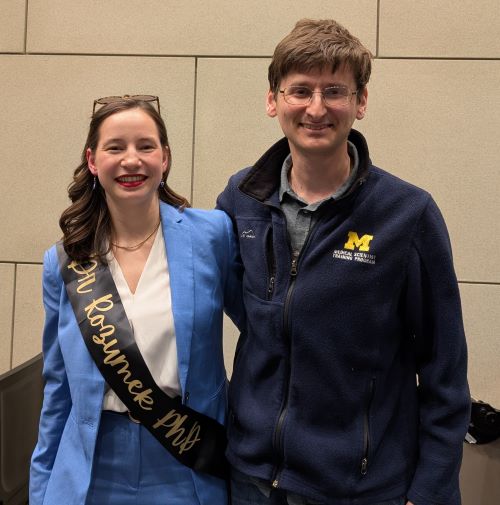 The Department of Pathology at the University of Michigan proudly celebrates the achievements of our graduating scholars, whose scientific curiosity, commitment, and resilience exemplify our department's mission. Among them is Gabrielle Rozumek, PhD, whose journey through the Molecular & Cellular Pathology (MCP) Graduate Program reflects both the spirit of inquiry that drives pathology and the profound humanity that underpins our field.
Growing up in rural Vermont, Rozumek did not have all the academic advantages found in larger school districts. “My school did not offer advanced placement classes or any specialized science courses. And I wasn’t even the best science student. I just really enjoyed it.” Her fascination with science began early, inspired in part by her mother’s experience with multiple sclerosis. “It was a hard disease to understand. One day she would be fine, and the next day, she would struggle. We became involved with the MS Foundation, and I began searching for information so I could understand it better.” That early search for answers led her to scientific literature long before she fully understood it, planting the seeds for her future as a researcher. However, no one in her family had ever attended college. “When I was young, my mom was thinking of having me do TV ads, but my great step-aunt, Kelly Flynn, PhD, told my mom, ‘Just let her get an education. She doesn’t have to do silly ads; she has a brain, let her use it.’ She has always been a driving force supporting me and my education. By the time I ended high school, I wanted to do something in neuroscience or biomedical science adjacent.”
However, Rozumek was also a talented soccer player, so when she began looking at colleges, she wanted a school where she could both play soccer and have strong biology offerings. Rozumek’s academic journey began at Roger Williams University, where she studied biology while playing collegiate soccer. “In my sophomore year, I noticed that some of my peers on the pre-med track were starting to do research, and I was curious about that. As a first-generation college student, I didn’t know I was supposed to do that to get into a good graduate program. So, I applied for my first summer fellowship at the University of Rhode Island with Dr. Jie Shen.”
 In the Shen lab, she was introduced to nanoparticle formulation to package a synthetic form of turmeric as an anti-cancer therapeutic for uveal melanoma. “I didn’t know that research was just 40 hours a week of getting to explore the kind of questions that you think are interesting.” Surrounded by graduate students, Gabrielle learned for the first time that a PhD could be both attainable and financially supported, an eye-opening moment that became a deciding factor in her pursuing a PhD.
"I didn't know research could be 40-hours-a-week of exploring questions you think are interesting."
One of the school administrators gave her a book, Finding Your North: Self-Help Strategies for Science-Related Careers, which is about people who pursued MDs, MD-PhDs, and PhD degrees, and provided helpful perspectives on why one would choose each path. “I also volunteered a few times at a health clinic, and it began to click for me that being in the healthcare clinical setting was not what I enjoyed, but I really enjoyed going to the lab and performing experiments and interpreting the data.”
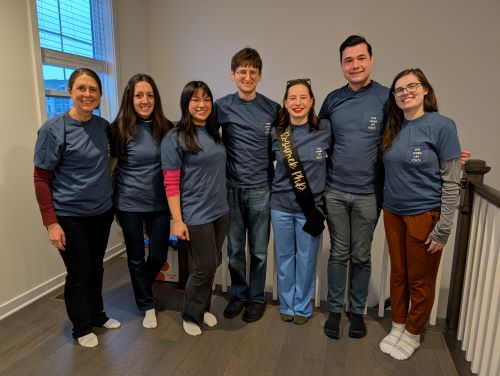
At the end of the summer, she returned to her home institution, where she joined Dr. Chris Burtner's laboratory and learned foundational skills in molecular biology and wet-lab techniques. She stayed in the lab and completed her senior thesis under his guidance. He encouraged her to apply to top-tier graduate programs and helped her craft her graduate school application. “I never thought of the University of Michigan before Dr. Burtner put it on my list of schools where I should apply. I didn’t know the university was as renowned as it is or had such a strong research program.” Gabrielle soon realized that the institution offered rigorous scientific training, strong mentoring, and a supportive community. “Michigan had so many good things going for it in addition to the academics. The affordability perspective was great; there were opportunities for training, funding, and health and wellness for the trainees; the cost of living made it possible to enjoy life as a trainee; and the community has lots of parks and trails to enjoy the outdoors. It quickly became my number one pick.” However, she was not immediately accepted into the program; “I was initially wait-listed, so I began to apply for prep programs to give me a competitive bump for the future.” Then the pandemic hit. “I think people withdrew due to the pandemic, so I got in.” She entered the MCP program in 2020, navigating the challenges of beginning graduate school during a global pandemic. Through outdoor meetups, pick-up soccer, and virtual connections, she built friendships across multiple graduate programs that would define her time at Michigan.
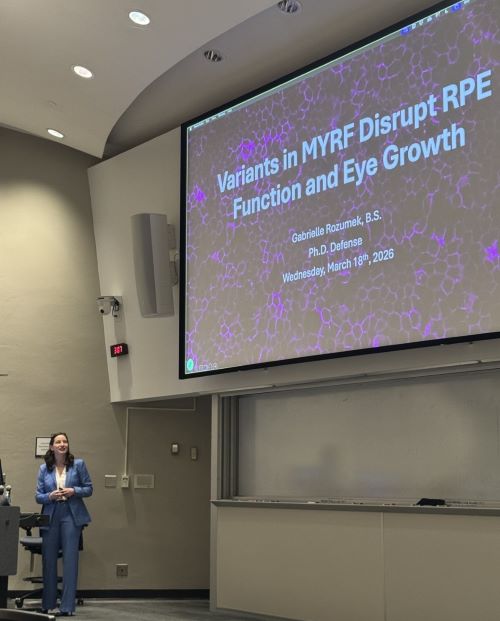
 Gabrielle ultimately joined the lab of Dr. Lev Prasov in the Department of Human Genetics, co-mentored by Dr. Andrew Lieberman in the Department of Pathology, where she embarked on groundbreaking research studying retinal pigment epithelium, particularly the MYRF variants associated with nanophthalmos, a genetic condition causing very small eyes, which can lead to vision loss. Her work revealed that a particular splice-site mutation leads to a partial loss of function in the MYRF transcription factor located at the C-terminus. She found that the MYRF variant acts as a hypomorphic allele driving the isolated nanophthalmos phenotype, and that, while it still allows normal processing, the protein stability of MYRF is reduced. Through a combination of humanized mouse models, molecular assays, and single-cell RNA sequencing, Gabrielle’s research offered new mechanistic insights and contributed to a better understanding of developmental eye disorders. Her first-author publication was recently published in JCI Insight, and she currently has additional manuscripts in progress.
Beyond her research accomplishments, Gabrielle became a pillar of service and mentorship within the MCP community. Through the University of Michigan’s U-MYScI program and Developing Future Biologists, she helped deliver scientific education to Detroit middle schools and mentored undergraduate students from across the country. Her leadership and scholarship earned her multiple awards including the NIH Graduate Summer Opportunities to Advance Research Fellowship (2022), the MCP Outstanding Service Award (2023), MCP Best Oral Presentation Award (2023), Phyllis M. Wise Biomedical Sciences Graduate Student Award for Excellence in Service (2024), and the MCP Outstanding Research Award (2025), recognizing the full breadth of her impact on the program. She also received funding from the James Grosfeld Initiative for Translational Dry AMD Degeneration (2025-2026) and the NIH-NEI Vision Research Training Program T32 (2023-2025).
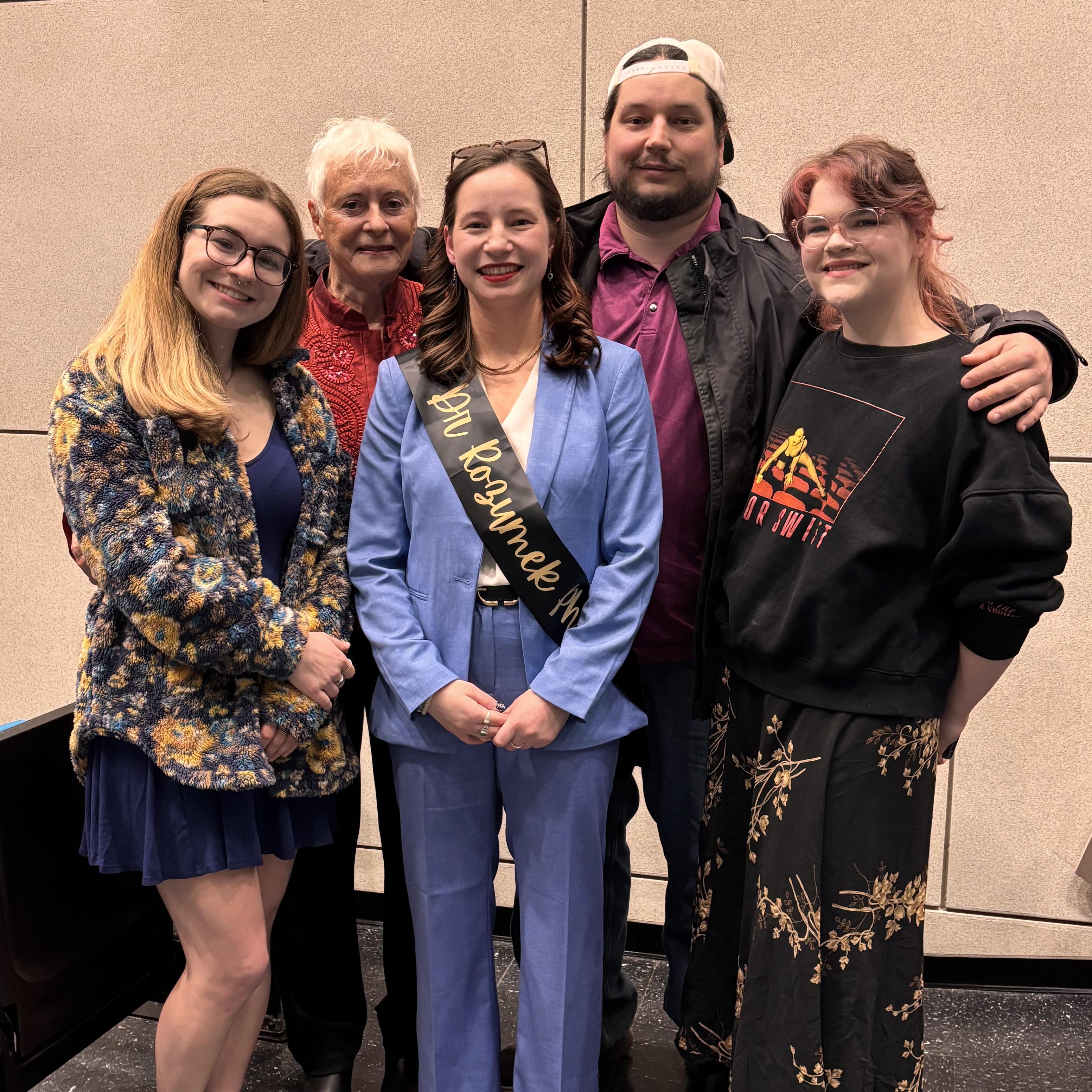 Gabrielle’s time in graduate school was not marked by achievement alone, but also by profound personal loss. The passing of her father in early 2025 made the final stretch of her PhD one of the most challenging periods of her life. Yet with the support of her siblings, Alfred and Anastasia (‘Bitty’), her mentors, and her community at Michigan, she found the strength to persevere. Her openness about this experience is a reminder of the unseen emotional labor of graduate training and the importance of checking in on those around us.
"Even when people seem okay, check in on them. Grad school is hard and life still happens."
Looking ahead, Gabrielle plans to pursue a postdoctoral fellowship focused on cell biology or trafficking, potentially staying within the epithelium. “I want to expand my abilities and, hopefully, apply for some independence pathway awards and eventually have my own research lab at an R1 institution.” She is driven by her passion for discovery and her love of mentoring the next generation of scientists.
Dr. Gabrielle Rozumek represents the very best of the Molecular & Cellular Pathology Graduate Program: scientifically rigorous, deeply compassionate, and committed to advancing knowledge and uplifting others. The Department of Pathology is honored to celebrate her achievements and looks forward to the many contributions she will make to biomedical science and to the communities she touches along the way.
 ON THE COVER
 ON THE COVER
 ON THE COVER
 ON THE COVER
 ON THE COVER
 ON THE COVER
 ON THE COVER
 ON THE COVER
 ON THE COVER
 ON THE COVER
 ON THE COVER