Arul Chinnaiyan awarded 13th annual Harrington Prize
By Anastazia Hartman | March 27Arul M. Chinnaiyan was awarded the 13th annual Harrington Prize for Innovation in Medicine, recognizing his groundbreaking identification of a gene fusion that drives prostate cancer.
Chinnaiyan is the director of the Michigan Center for Translational Pathology and the S.P. Hicks Endowed Professor of Pathology at Michigan Medicine.
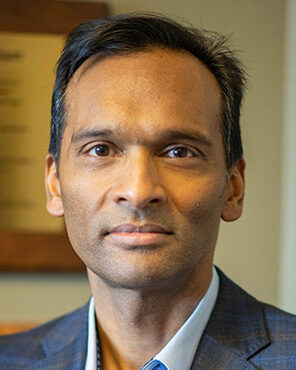 The award was given jointly with Charles L. Sawyer, Marie-Josée and Henry R. Kravis Chair in Human Oncology and Pathogenesis at the Memorial Sloan Kettering Cancer Center. Chinnaiyan is the first recipient from U-M to receive the Harrington Prize.
The award recognizes their transformative discoveries that defined the molecular drivers of prostate cancer and pioneered precision therapies that have reshaped the diagnosis and treatment of prostate cancer worldwide.
The Harrington Prize for Innovation in Medicine, established in 2014 by the Harrington Discovery Institute at University Hospitals and the American Society for Clinical Investigation, honors physician-scientists who have moved science forward with achievements notable for innovation, creativity, and potential for clinical application.
Chinnaiyan’s discovery of the TMPRSS2-ERG gene fusion, the most common genetic alteration in prostate cancer, has become the basis for early diagnosis and a driver of precision oncology strategies. Sawyers provided key insight into the role of the tumor suppressor gene PTEN in the pathogenesis of prostate cancer.
“I am truly honored by this recognition from the Harrington Prize for Innovation in Medicine,” Chinnaiyan said. “This award belongs to the many outstanding colleagues, trainees and collaborators I have had the privilege to work with, whose dedication continues to drive meaningful advances in cancer research and patient care.”
The pair co-led a team that discovered high rates of mutations in advanced prostate cancers that make them susceptible to a class of drugs called PARP inhibitors, such as olaparib. Today these drugs are a standard treatment for prostate cancer.
Together, Chinnaiyan and Sawyers have developed the contemporary framework for diagnosis and treatment of advanced prostate cancer and a basis for next generation therapies. The Harrington Prize for Innovation in Medicine recognizes their impact in improving outcomes in this deadly disease.
“The Harrington Prize recognizes scientific breakthroughs that change the course of medicine, and the work of Drs. Chinnaiyan and Sawyers exemplifies this mission. Their ground-breaking discoveries in cancer genomics and precision oncology demonstrate the extraordinary impact of scientific curiosity paired with clinical purpose,” said Priscilla Hsue, Chizuko and Nobuyuki Kawata Chair, Chief of Cardiology at UCLA; professor of medicine in the David Geffen School of Medicine UCLA; and 2025-26 ASCI president.
“Drs. Chinnaiyan and Sawyers embody the very best of physician‑scientist innovation. Their contributions underscore the power of advancing bold scientific ideas all the way to patient care, and they inspire a generation of innovators committed to turning discovery into cures,” said Jonathan S. Stamler, president and co-founder of Harrington Discovery Institute; Distinguished University Professor, Robert S. and Sylvia K. Reitman Family Foundation Chair of Cardiovascular Innovation, and Professor of Medicine and of Biochemistry at University Hospitals and Case Western Reserve University.
A committee composed of members of the ASCI Council and the Harrington Discovery Institute Scientific Advisory Board reviewed nominations from leading academic medical centers from seven countries before selecting the 2026 Harrington Prize recipient.
In addition to receiving the Prize’s $20,000 honorarium, Chinnaiyan and Sawyers will deliver the Harrington Prize Lecture at the 2026 AAP/ASCI/APSA Joint Meeting on April 17, and they will be featured speakers at the 2026 Harrington Scientific Symposium on May 20. They are invited to publish an essay in the Journal of Clinical Investigation.
 ON THE COVER
 ON THE COVER
 ON THE COVER
 ON THE COVER
 ON THE COVER
 ON THE COVER
 ON THE COVER
 ON THE COVER
 ON THE COVER
 ON THE COVER
 ON THE COVER